Showing posts with label trinovid. Show all posts

Sunday, January 10, 2010

Binocular Basics - 2: numbers


All binocular models have a a brand and model name followed by a series of numbers to describe them. This "nomenclature" can give you some important information about the binocular. However, it requires a bit of knowledge to understand how these characteristics affect performance.

The binocular model above is a Leica 7x42 Ultravid HD. Leica of course is the manufacturer, and the model name is the "Ultravid HD". The model name is derived from the Latin root "vid" meaning "to see", and HD indicates that this model contains the highest level of flouride-infused glass, offering the best possible color rendition possible. Manufacturer & model numbers are of course random and vary between models, and don't tell you much about performance. The "nomenclature", however, (the series of numbers) are consistent throughout the industry and tell the consumer a lot about the product.

The product above is an older model, a Leica Trinovid 10x42 BN. Lets consider just the nomenclature on this product the "10x42" portion - "10x" describes the power of magnification. As you'd suspect, this binocular magnifies the subject 10 times. This means your subject will appear 10 times larger or 10 times closer than it does when viewed with your eyes alone.


The image above is a representation of a subject at 1x and 10x respectively. Unfortunately, at this size the graphic is not very effective because it is difficult to see well. The most popular powers of magnification in binoculars are generally 7x, 8x, and 10x. It is common for people to assume more magnification is better than less. However, it is important to remember that you are not only magnifying your subject, but you are also magnifying all the hand shake and movement from wind, etc.

Most people cannot hold a binocular with more than 10x magnification still enough to benefit from the increased power. As a matter of fact, many are surprised to realize that when comparing binocular models within the same manufacturer's line, that they resolve details better with a lower-powered binocular. When trying to decide which binocular is right for you, it is best to use a resolution chart (the optical equivalent of an eye chart). In lieu of a resolution chart, a dollar bill (or similar) usually offers suitable fine print for this test. Simply, hang one to the wall and compare which binocular power within a given line allows you to discern more detail. For me, I find I can discern more detail with a lower-powered binocular. I just can't hold a higher-powered glass steady enough to benefit from the increased power, and typically use a 7x42 binocular (7 times magnification) - I feel I see more detail on a smaller and brighter subject.


The second number describes the diameter of the objective lens in millimeters. The binocular above is an Ultravid 8x32. It magnifies 8x and the objective lens is 32 mm wide. In this binocular a 32 mm circle of light enters the binocular (the diameter of the objective), however for every 1x of magnification you must reduce the size of the circle of light entering your eye by the same power. Therefore, the circle of light seen coming out of the eyepiece & entering your eye is 32 mm divided by 8x, or 4 mm (see above). This circle of light is defined as the "Exit Pupil".
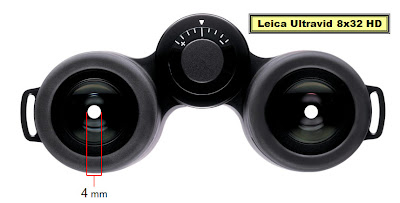


How does exit pupil affect binocular performance?.... Well again, all else being equal (assuming we are considering one particular line of a given manufacturer's products), a larger exit pupil means more light enters your eye.


In bright light, when your pupil is fully constricted, exit pupil is less important. However, in low lighting conditions your pupil dilates/expands. So an exit pupil of 4 mm may not fill every cone and rod in your pupil, where the 7x42 above with a 6 mm exit pupil will deliver a brighter image with superior resolution under these conditions. Also, as your hands shake, a smaller circle of light will be harder to stay over your pupil, while a larger exit pupil will continue to deliver consistent light to your eye. While your brain may well assimilate the image, over a full day's use your eye may feel more strain and discomfort with a smaller exit pupil, compared to the binocular with the larger exit pupil (once again assuming the same binocular quality/line).


Of course, this is but one consideration in binocular selection, and each individual will have to balance power & objective size, versus binocular size/weight & ease of use/ergonomics. This personal balance will obviously vary from user to user, but I think it safe to say that if "lightweight" and "compact" are two of your main criterion for binocular selection, it is true to suggest that within a given line, this cannot be achieved without sacrificing some optical performance. However, we will consider this fully in another post!

Thursday, January 7, 2010

Binocular Basics 1

This is the first post in a series that will review binocular basics for those interested. As you'd expect I'll start at the very beginning with very basic information. Throughout the series though the information will get more complex. Feel free to comment or question in the comments section below though.


Generally speaking, binoculars are manufactured in two basic designs in regard to prism assembly and structure. The first is a "porro prism" design which is easily recognized by shape. In a porro prism binocular the eyepiece or ocular lens assembly, is offset from the distal objective lens assembly. In most cases the objective lens will sit outside the eyepiece, although some manufacturers offer compact "reverse porro prism" designs where very small objective lenses nearly touch and are much closer together than the ocular.
I've superimposed the typical shape of a porro prism assembly in red lines above while the green dashed line shows the light path as it travels through the binocular. Note how the light enters the objective lens cell, passes into the upper prism, is reflected 2 times, passes into the lower prism block, bounces two more times and finally exits through the eyepiece.

Roof prism binoculars are quite different in structure and are generally favored for their superior ergonomics. In a roof prism binocular the ocular and objective lenses are lined up in a straight line (not off-set as in porro prism designs). Once again, I've drawn a rough roof prism assembly in red and the dashed, green line represents the path of light travel through the system.
As always, the light enters through the (typically larger) objective lens and travels up to the prism assembly. The assembly (in this case) is compromised of two glass blocks just as in the porro design at top. Unlike the porro however, a roof prism assembly reflects the light 5x. The area where the two blocks meet is called the "interface mirror", and this surface has to both reflect light at points and allow light to pass in others. It is very difficult to accomplish this without losing light through back reflection and/or refraction though, and the angles are more crucial than in simpler porro designs. As such, roof prism binoculars average more expensive than a comparable porro prism.

This higher price adds some very real advantages though to include: superior ergonomics, better waterproofing, and a higher impact resistance (again assuming a comparable level of manufacture and design). Roof prism binoculars generally offer better ergonomics through their slimmer design, as porro prism binoculars average bulkier due to the offset design.
Most porro designs utilize a moving external bridge (see above) that slides the oculars in and out to achieve focus. Once again, this is a simpler and cheaper manufacturing design, however it suffers from one predictable flaw. As these tubes slide over top of one another you are continually wearing the seals that keep moisture out and inert gases in. Over time these will wear to the point of failure leading to moisture problems and internal fogging. In addition this external bridge is very susceptible to impact damage, leading to alignment problems as well.

In most roof prism binoculars the focusing system is internal. In the case of the Leica Ultravid above, internal "field collector lenses" move back and forth between the prism assembly and objective lens cell. Since this system is completely internal it is much more impact resistant, and since you are not constantly wearing the seals through abrasion the roof prism design maintains its water proofing & fog proofing.

Summary
As a final note, I need to qualify implications above. I've used words like generally & typically above and also used qualifying statements like, "assuming comparable quality". In most cases in optics the old adage, "You get what you pay for" is true to its word. In looking at binocular prices quickly online, I note full-sized porro prism binoculars (compacts excluded) range from just over $25 up to about $1,200 US. By comparison roof prism prices ranged from about $50 on up to nearly $3,000 US. Assuming less expensive binoculars are created by cutting costs on raw materials (quality of components), manufacturing costs (quality of construction), & labor costs, I certainly expect that a $1,200 dollar porro prism would out-perform a $100 roof prism in every way. However, if we compared the highest quality premium roof prism versus the highest priced porro prism, I'm certain most users would prefer and gravitate toward the roof prism. I say this from my own personal preferences, my experiences of meeting and birding with thousands of birders annually (and noting what binoculars they are using), and from my knowledge of the many independent reviews that have appeared in industry articles in varying popular publications. All suggest roof prism designs are favored across the board by most users.

Tuesday, June 23, 2009

Recent Anniversary for Leica


Leitz Optics Works, 1913, Wetzlar, Germany

It's now been 5 years since I was approached by Leica and asked to be their representative to the birding community. My answer was an immediate & resounding "Yes!" as I knew all about the quality of the products as a seasoned birder. I was not, however, very familiar with the rich optical history of the company. In 2007, I had the fortunate task of assisting with organizing displays celebrating Leica's (originally Leitz) 100th anniversary of producing commercially available binoculars.
Leitz Binocle 6x18 binocular, 1907


Leitz had been producing premium, precision optics (mainly microscopes) in their Wetzlar, Germany plant (top) for nearly 60 years when they introduced their first commercially available binocular on May 14, 1907. The resultant Leitz Binocle 6x18 was the first binocular introduced and it was followed by a number of similar products to include the Leitz Binodal 6x21 (1908 - 1919), and the highly stylish little Gallilei (below) in 1912.

Leitz Gallilei binocular, 1912


As today, these early Leica binoculars were praised for their high quality imaging and in World War I the US Navy borrowed these optical treasures from US citizens as part of their "Eyes for the Navy" program. Like the Leitz Binominia below, each borrowed binoc was engraved with a serial number and cataloged by the US Navy for return at the end of the war.

Leitz Binominia 4x16 binocular, 1914
If the binoculars had not been lost, each was returned to the original owners with a single US dollar bill and a note from the then Assistant Secretary of the Navy.... future US president, Franklin D. Roosevelt!
The early Leitz binocular line included more than smaller, low-powered models though. Large 12x60 binoculars showed up starting in 1910 and the classic brass bodied 10x50 Aviodix (below) were manufactured for the military beginning in 1917.
Leitz Aviodix 10x50, brass-bodied binocular, 1917


Not surprisingly, Leitz pushed the envelope of technology, and by 1927, more contemporary-looking models of porro-prism binoculars like the Leitz Binuxit 8x30 were commercially available.

Leitz Binuxit 8x30, 1927

The stylish Leitz Amplivid really changed the path of the Leitz line-up forever though. This amazing 6x24 roof-prism design (1955) offered a revolutionary wide-angle view of greater than 600 feet at 1,000 yards! This incredibly well-received product, marked the end of porro-prism models at Leitz.

Leitz Amplivid 6x24 binocular, 1955

Following the huge success of the Amplivid, Leitz developed its first model of the famed Leitz Trinovid. Named for the latin root "to see" (-vid), the trinovid introduced three novel (Trino-) innovations to the industry when first introduced in 1957 which has been copied ever since:

1) slim construction

2) superior ergonomics

3) true internal focus system

Leitz Trinovid I prototype, 1955

These first generation models were short lived and were soon replaced with the more familiar, slightly shorter 2nd generation models. Due to the limited run time, these early Trinovids are a big hit amongst collectors (be sure to check your attics thoroughly!)

Leica Trinovid BN 10x42

The amazingly popular, sleek, leather-bound 2nd generation Trinovids remained in the market place for over three decades, until the robust 3rd generation Trinovid hit the market in 1990.

With a new name, Leica went to the marketplace in the mid 1980's and asked consumers and industry leaders what they wanted to see in their binoculars. It seemed serious optics users wanted a more robust, completely waterproof product that could handle any elements one might throw at it. One thing that wasn't apparent in this early survey though, was a demand for close-focus. The earlier Leica Trinovid BA binoculars focused to only about 18 feet, however in response to market demand, (especially birders) Leica made a rolling change in the Trinovid line in the year 2,000. The newer Leica Trinovid BN now close-focused to ~6-9' depending on the model in question.

This trend continues today and demands for lighter weight products have been answered by the Leica Ultravid BR line (the most waterproof binocular in the industry today), which also had significantly improved light transmission over older Trinovids. As recently as 2007, the latest round of inovation (the Leica Ultravid HD line) now allows users to send water droplets sailing with a flick of a wrist. Handy if you're like me, and don't have sense enough to get out of the rain!